
Walk through any shop today and you will see the word “recycled” on labels, hangtags and shop windows. Sometimes it means something real. Often it does not. Three words get used interchangeably — recycled, upcycled and downcycled — and they describe very different things. Knowing the difference is the single most useful thing you can learn before buying “sustainable” clothes.
Recycled: broken down, then rebuilt
Recycling takes a material back to its raw form and makes something new from it. In fashion that usually means one of two routes. Mechanical recycling shreds old textiles into fibre, which is then spun into new yarn. Chemical recycling dissolves the fabric and rebuilds the polymer from scratch. Both use energy, water and machinery, and both weaken natural fibres: a cotton t-shirt can only be mechanically recycled a few times before the fibres are too short to spin.
Recycling is still far better than landfill. But it is industrial, and the honest version of the label should say how much recycled content a garment contains. “Made with recycled fibres” can mean 5%.
Downcycled: still useful, but worth less
Most textile “recycling” in the world is actually downcycling. Old clothes become insulation, car-seat stuffing, industrial rags or mattress filling. The material is kept out of the ground for one more cycle, but it has moved down the value chain and will almost certainly be thrown away next time. Downcycling is a delay, not a solution.
Upcycled: the material keeps its value, or gains it
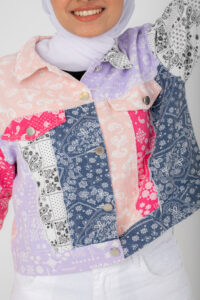
Upcycling skips the breaking-down step entirely. The fabric is used as fabric. A discarded pair of jeans is cut into panels and becomes part of a new jacket. Offcuts from a factory floor are pieced together into a vest. Nothing is melted, shredded or dissolved, so the energy cost is close to zero and the fibres stay as strong as they were.
This is what Green Fashion does. Every piece we sell starts as reclaimed clothing or production waste that someone was about to throw away. It is washed, sorted by colour and weight, cut by hand and sewn into a garment that is worth more than the material it came from. That last part is the definition of upcycling: the value goes up.
How to read a label in ten seconds
- “Recycled polyester” is usually made from plastic bottles, not old clothes. It keeps bottles out of landfill but still sheds microplastics.
- “Made with recycled materials” with no percentage is a marketing phrase. Ask for the number.
- “Upcycled” should mean the original fabric is visible in the finished piece. If it looks like a normal mass-produced garment, be sceptical.
- “Handmade from reclaimed fabric” is the strongest claim, because it cannot be done at fast-fashion scale.
Why the difference matters
Textile waste is not a shortage of good intentions. It is a volume problem: the world produces more than 100 billion garments a year and most of them are worn a handful of times. Recycling at that scale needs factories; downcycling only postpones the landfill; upcycling is the only route that turns the waste itself into the product. That is why we built our workshop around it, and why every piece on our rail looks different from the next one.
Next time you see one of these three words, ask which one it really is. The answer tells you almost everything about the garment.